
With AI agents, writing code is no longer the expensive part. The expensive part is knowing what to build, for whom, and answering for what goes to production. That is where humans remain irreplaceable.
In two years, software making has changed in nature. An agent like Claude Code or a platform like Lovable can produce in an afternoon what used to take a full sprint: a screen, an API, a database schema, a test suite. For a leader or product manager, it is tempting to conclude that the product team is becoming optional.
The opposite is happening. When code becomes abundant, judgement becomes scarce. This article describes what agents genuinely do well, the six responsibilities humans don't delegate, and how a product team organises itself when it works with agents every day.
What AI agents have really changed
Agents have collapsed the cost of execution, not the cost of decisions. They excel at anything well specified and verifiable:
- Building fast: a clickable prototype in hours, a complete feature in a day.
- Exploring wide: three variants of an onboarding flow instead of one, for the price of one.
- Absorbing thankless work: migrations, tests, documentation, refactoring, API integrations.
- Reading and explaining: an agent walks an unfamiliar codebase and summarises its architecture in minutes.
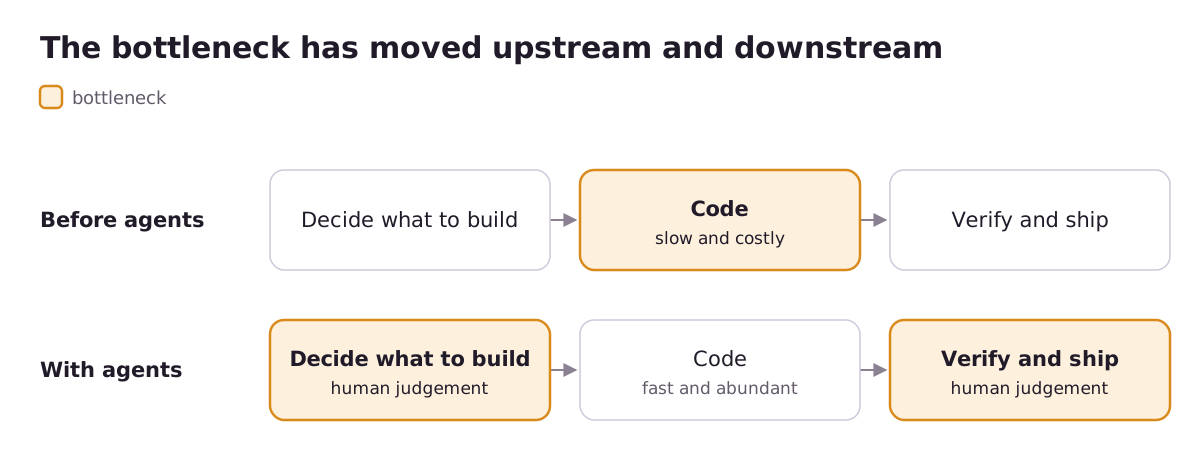
The direct consequence: the bottleneck has moved. It is no longer the capacity to code, but upstream (knowing what to ask for) and downstream (knowing whether the result is good). A team that doesn't strengthen both ends simply ships faster… things nobody needs.
The six responsibilities humans don't delegate
An agent executes an intention; it doesn't own it. Six responsibilities stay on the human side, and they now weigh more than before.
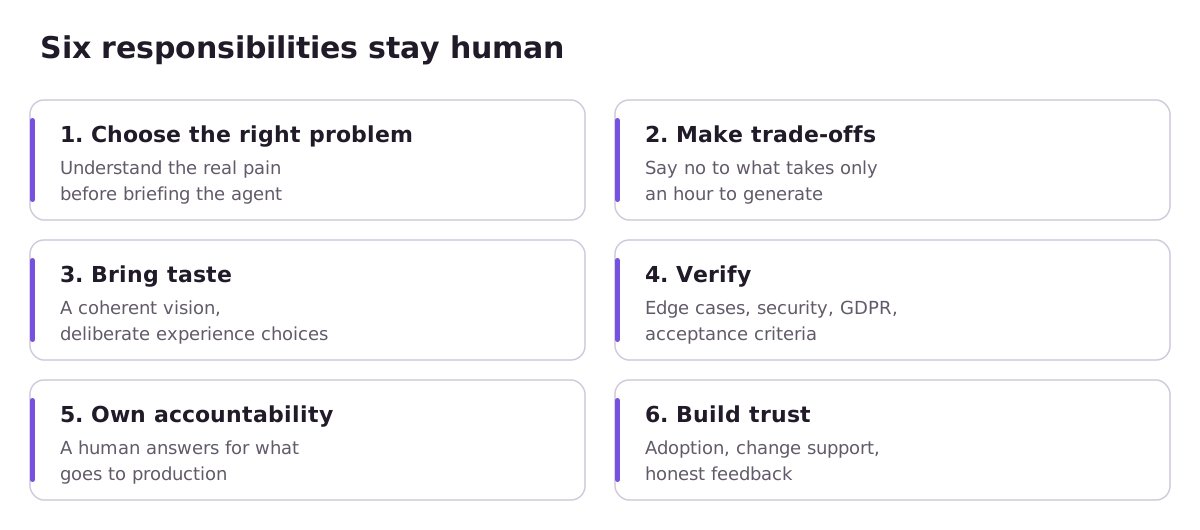
1. Choose the right problem
An agent answers the question you ask, never the one you should have asked. Understanding a user's pain, how often a task occurs, what a customer is willing to pay: that takes interviews, fieldwork and empathy. No prompt replaces a coffee with an unhappy customer.
2. Make trade-offs
When everything becomes quick to build, the question is no longer “can we?” but “should we?”. Saying no to a feature that takes an hour to generate but months to maintain and explain is an act of product leadership. The backlog has never needed an owner more.
3. Bring taste and coherence
By default an agent produces “fine”: the average interface, the standard flow. What sets a product apart is a coherent vision: a tone, deliberate experience choices, a simplicity that requires giving things up. Taste remains a human signature.
4. Verify
Generated code is plausible by construction, which makes it dangerous when it is wrong. Someone has to read, test, and question edge cases, security, personal data handling and GDPR compliance. The faster the agent produces, the more structured the review must be: clear acceptance criteria, automated tests, validation environments.
5. Own accountability
When an invoice goes out with the wrong amount or customer data leaks, “the AI wrote it” is not an acceptable answer. The company, and therefore a human, answers for what goes to production. That accountability means staying in control of what ships, even when you didn't write it yourself.
6. Build relationships and trust
Selling, supporting change, gathering honest feedback, bringing a business team on board: software only exists if it is adopted. This relational side of product remains deeply human, and it often decides success.
What an augmented product team looks like
In a team working with agents, the product cycle tightens: only one step in four is handed to the machine. The other three require human judgement, and that is where value is created.
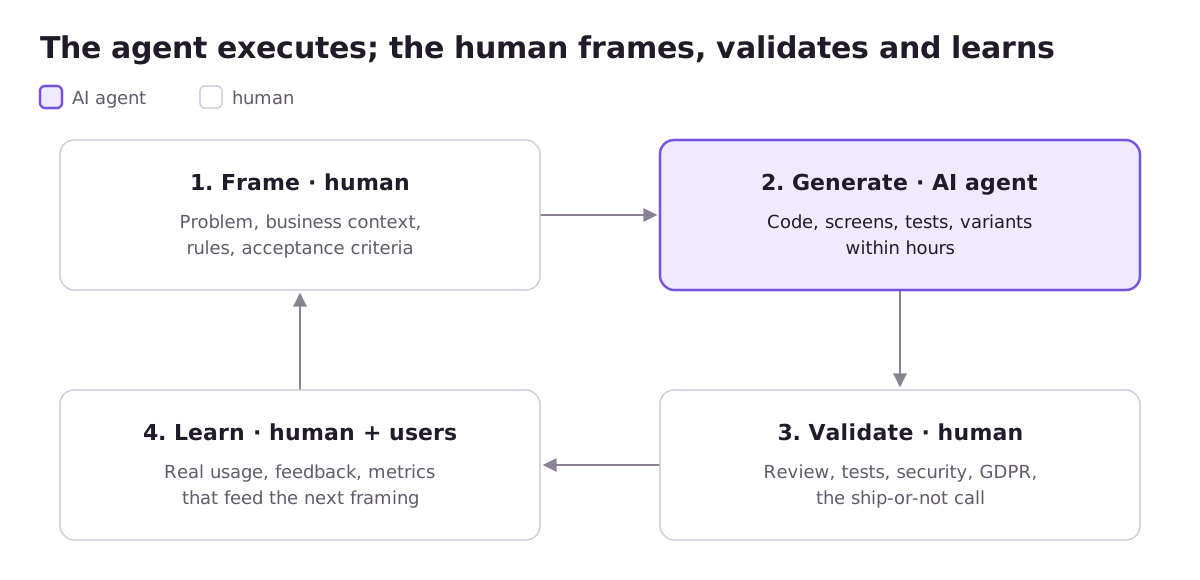
The cycle runs in days rather than weeks, which multiplies the chances to learn. Roles evolve accordingly:
- The product manager becomes the keeper of intent: writing specifications precise enough for an agent to execute and clear enough for a human to verify.
- The engineer moves from writing to supervising: architecture, review, security, structural technical choices.
- The designer defines the principles and design system the agent applies, rather than drawing every screen.
- The leader sets direction and guardrails: what gets automated, what always gets checked, who approves releases.
Three traps to avoid
Speed without direction. Shipping ten features a week is worthless if none moves a business metric. Measure impact (adoption, retention, time saved), not volume shipped.
Invisible debt. A prototype generated over a weekend can become the foundation of a production product without anyone deciding it. Architecture, access security, data structure: these choices must be made deliberately, and reviewed, before scaling.
The illusion of competence. Because the agent succeeds, you think you're in control. The day it gets something wrong, the team still has to understand its own system. Keep at least one person able to read, explain and fix what was produced.
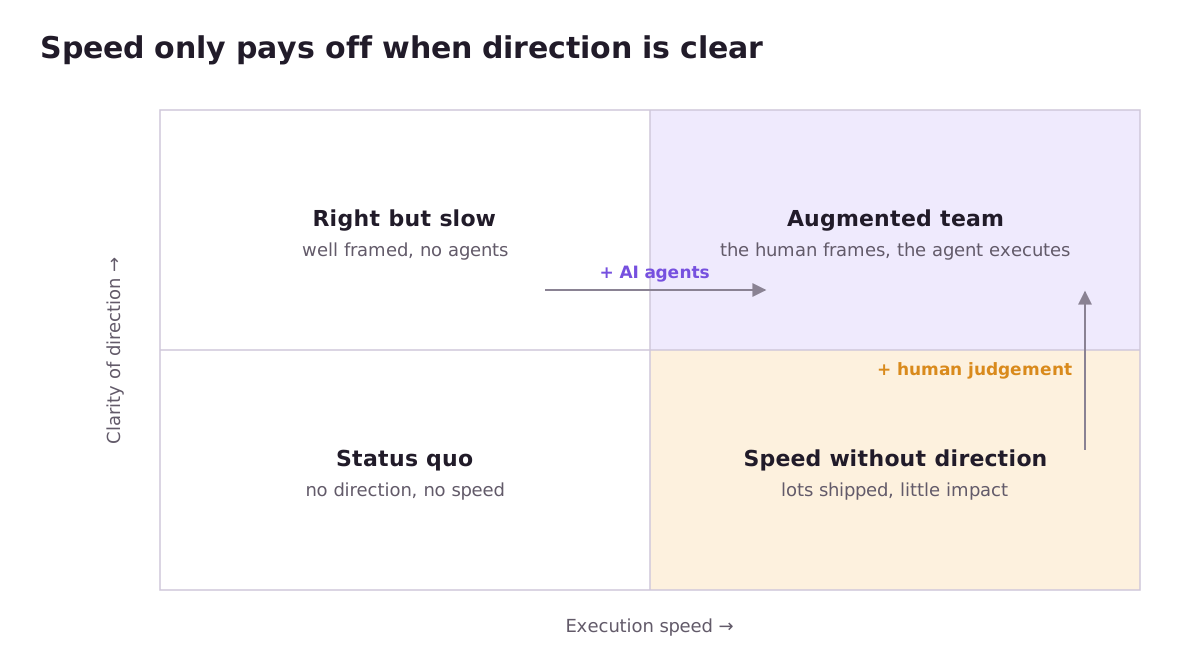
Agents bring speed, but only human judgement provides direction. The goal is the top-right quadrant, not just the right half.
Our experience at Kreapp
At Kreapp, an official Lovable partner in France, we build SaaS products and internal tools with Lovable and Claude every day. The examples above come from that portfolio: THIIA, Advisor Nexus CRM, LIIAM, risk reports for insurance. Three lessons stand out.
- Time saved on code is reinvested in discoveryWe spend more time with business users, because we can show them a working prototype by the second meeting.
- Output quality depends on framing qualityA well-briefed agent (business context, rules, examples) produces far better results than one asked for “an invoicing app”.
- Product and technical expertise remains decisiveIt is what turns an impressive prototype into a reliable, secure and maintainable product.
That is also why expert support makes sense: the tools are available to everyone, but steering them to ship a product that holds up in production is still a craft.
Conclusion: less code, more product
AI agents don't replace humans in software creation; they take away the excuse of execution. What remains is the core of the job: understand, choose, verify, own. The teams that win won't be those generating the most code, but those asking the best questions and holding the course.
Want to build a SaaS or internal tool with Lovable and AI agents without losing control of your product? Kreapp supports you from framing to production.
Let's talk about your project